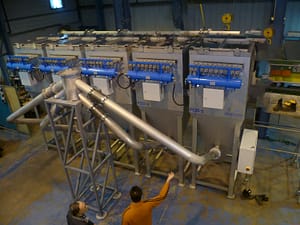




In advanced metallurgical, additive manufacturing, and chemical recovery processes, hot gas filtration is no longer limited to dust removal alone. Gases such as carbon dioxide, helium, argon, and process vapours must be filtered while maintaining chemical purity and system stability. High temperatures, often exceeding 600°C, combine with highly reactive or low-density dusts like titanium, magnesium, or aluminium to create complex filtration challenges. Standard filter systems either break down under thermal stress or compromise gas purity through material interaction or entrainment.
This article explores how ceramic filters at 700°C or higher can be engineered to handle CO₂-rich and chemically reactive environments—while maintaining ultra-low pressure drop and mechanical stability.
Understanding Reactive Dusts
Dusts generated from titanium, magnesium, aluminium, or mixed alloy processes present significant reactivity risks when exposed to oxygen, moisture, or heat. At elevated temperatures, these particulates can ignite, oxidise, or fuse to filter media. The challenge becomes not just filtration efficiency, but system safety, gas containment, and long-term material compatibility. Titanium dust, for example, may auto-ignite in oxygenated atmospheres at temperatures above 500°C. Magnesium and aluminium may bond to metallic filter surfaces, particularly under thermal cycling or low-flow conditions.
In CO₂-rich atmospheres, corrosivity can also become a concern, especially when combined with trace chlorides, sulphur, or moisture. These environments require materials that are chemically inert and able to retain performance despite prolonged exposure to temperature gradients and particulate attack.
Ceramic Filter Compatibility with Inert and Reactive Gases
Ceramic hot gas filters offer a high degree of chemical and thermal stability, making them well suited for inert and reactive environments. Their monolithic structure avoids seams, welds, or joins that could corrode or degrade over time. The extruded ceramic matrix remains stable at temperatures up to 1000°C, and is inherently non-reactive with CO₂, helium, nitrogen, or rare gases. Importantly, ceramic filters can be tailored by porosity and wall thickness to suit application-specific flow and particle loading profiles.
Advanced element designs, including closed-end plug configurations, prevent dust ingress into the filter body and ensure cake formation remains on the external wall for efficient backpulse cleaning. This prevents dust loading from penetrating internal surfaces and avoids long-term clogging or purity compromise.
Low Pressure Systems (e.g. 500 mbar)
Gas recovery and metallurgical systems often operate at reduced pressures—sometimes down to 500 mbar or less. In such conditions, pressure drop across the filter becomes a critical factor. Ceramic filters can be optimised to maintain very low clean gas pressure drop, typically under 10 mbar, depending on element geometry and cake characteristics. Because the system cannot rely on excess upstream pressure to force gas through, element selection, system layout, and pulse cleaning performance must be engineered precisely.
Computational Fluid Dynamics (CFD) modelling is frequently used to simulate flow patterns, temperature distribution, and particulate behaviour across the filter array. This helps prevent uneven loading, element bridging, and localised hot spots—particularly important in narrow or modular housing configurations where space and weight are constrained.
Backpulse Cleaning in Sensitive Environments
Unlike bag filters, ceramic filter systems use dry compressed air for backpulse cleaning. This eliminates the need for water, wash-downs, or fibre-reinforced sleeves that can degrade under heat. The pulse-jet system dislodges the external dust cake without disturbing the gas phase, maintaining downstream purity. Since there are no moving filter bags or mechanically actuated shakers, the system runs with low wear and minimal maintenance even in 24/7 operation.
This is particularly beneficial in chemically sensitive gas systems where contamination must be avoided. Pulse parameters—pressure, frequency, duration—are calibrated to avoid damaging fine powders like titanium or magnesium, which may become airborne or electrostatically bonded. This balance between effective cleaning and minimal disturbance is a critical factor in maintaining long-term performance in reactive gas streams.
When You Need Purity – Protecting Downstream Gas Recovery Systems
Many gas systems ultimately feed into recovery, recirculation, or analysis equipment—such as gas chromatography, membrane separation, or cryogenic storage. In these cases, particulate carry-over can degrade equipment performance, foul membranes, or trigger unwanted chemical reactions. A hot gas filter for reactive dust must act not only as a particulate barrier but as a stabilising interface between the high-temperature process and the clean gas recovery section.
By using ceramic filters with proven thermal and chemical resistance, plant designers can ensure that CO₂ and other recovered gases remain uncontaminated. Ceramic systems introduce no fibres, no oils, and no volatiles, making them compatible with high-purity applications such as additive manufacturing powder recycling, metal halide vapour separation, or closed-loop CO₂ reuse in green fuel production.
Filtering CO₂-rich or reactive gases at elevated temperatures demands a materials-first design philosophy. Ceramic filters provide the structural, thermal, and chemical resilience needed to capture reactive particulates while preserving gas phase purity. From titanium and magnesium dusts to high-value gas recovery systems, a well-designed ceramic filter solution offers safety, longevity, and consistent performance—even under demanding operational profiles.