



Not every project starts with 10,000 m³/h of flue gas or a full-scale emissions permit. Many of the most important innovations—especially in carbon capture, advanced pyrolysis, and fuel synthesis—begin in labs, pilot plants, or demonstration rigs. But even at small scales, clean emissions and reliable gas data are essential. Whether it’s proving a process to investors, meeting local air quality thresholds, or simply protecting downstream analysis equipment, pilot plant hot gas filters must perform to the same technical standards as their industrial counterparts.
This article explores how compact ceramic filter systems enable high-efficiency filtration for flows as low as 100 m³/h—all while handling temperatures up to 1000°C. The aim is to give engineers, researchers, and clean tech startups the tools to design smarter, scalable gas treatment right from the start.
The Problem with ‘Too Big’ Filters
In many pilot installations, engineers are forced to adapt industrial filtration hardware to small-scale use. This often means oversized filter housings, underloaded elements, and systems that require more energy and infrastructure than the pilot system itself. Overspecification not only adds cost but risks compromising performance—where low velocity or unformed dust cake leads to poor capture or pulse inefficiency.
Space is another challenge. Most pilot rigs sit in converted labs, container units, or mobile enclosures. There’s rarely room for a multi-tonne baghouse or tall discharge stack. What’s needed is a filtration system designed specifically for small flows, without sacrificing pressure stability or particulate capture.
What Are Your Options at 100–2000 m³/h?
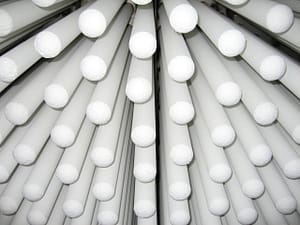
Ceramic filter systems are now available for gas flows as low as 100 m³/h. These use single-element housings or compact three-element cartridges designed to maintain appropriate gas velocity and ensure cake development. At the upper end, flows of 2000 m³/h can be handled with modular HTMC (High Temperature Modular Cartridge) systems, scaled in rows without affecting control logic or pulse cleaning.
These units are tailored for pilot-scale gasifiers, pyrolysis reactors, lab-scale calcination, or carbon conversion rigs. Some designs even incorporate integrated reagent injection for dry acid gas scrubbing in CO₂-rich or HCl-laden gas streams. Importantly, they are easy to transport, install, and reconfigure as the project evolves.
Temperatures up to 1000°C – Still Doable
Small scale doesn’t mean low performance. Ceramic elements used in compact systems are the same grades deployed in full-scale plants—rated to handle gas streams at 400–1000°C continuously. These filters resist thermal shock, retain dimensional stability, and support PM2.5 capture even under fluctuating conditions.
Housing materials are selected based on the upper temperature limit and corrosivity of the gas. For dry, clean combustion gases, carbon steel with insulation may suffice. For higher-spec environments—such as metal vapours, chloride-laden flue gas, or cyclic shutdowns—stainless or alloy steels ensure integrity. Systems are often modular, allowing the housing material to be upgraded as the project scales.
Plug-and-Play vs Built-In – Mounting Options
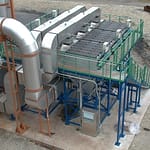
Mounting flexibility is vital at pilot scale. Some sites prefer standalone plug-and-play filter modules, complete with fans, pulse systems, and hoppers mounted on skid frames. These can be dropped into a test rig or shipped between trial locations with minimal rework. Others opt for built-in filtration, designing the filter housing into the thermal envelope of their reactor or process unit.
Both approaches are valid. Plug-and-play allows fast commissioning and repositioning. Integrated designs offer tighter footprint and heat retention. Many developers start with standalone filter skids and later transition to in-situ filters as scale and permanence increase.
Buying or Renting – Flexibility for R&D
When it comes to early-stage projects, flexibility is as important as performance. Rental units—particularly compact ceramic filter skids—allow proof-of-concept without long lead times or capital outlay. This is especially valuable in grant-funded or phased R&D programmes, where budget cycles don’t always align with hardware procurement.
Many suppliers now offer rental terms for lab gas filter systems, including support for installation, commissioning, and emissions testing. Buying remains the better option for long-duration pilots or semi-permanent demonstrators. However, the availability of proven, small-scale filtration—whether rented or owned—means cleaner data and faster iteration cycles for early-stage tech.
Clean, consistent emissions are just as important at 500 m³/h as they are at 50,000 m³/h. With today’s small-scale ceramic filter systems, engineers and innovators can capture high-temperature particulates with confidence, meet planning or regulatory thresholds, and prepare their technology for industrial deployment.
Whether in academic R&D, startup prototyping, or industrial demonstration, choosing the right filtration strategy from the start can reduce risk, improve data quality, and pave the way for scalable success.