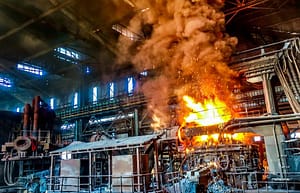




Power generation plants can produce high-temperature gas streams containing fine particulate, ash and treatment residues. Filtration is critical where operators need to protect downstream equipment, support emissions compliance and maintain reliable plant operation.
Glosfume provides hot gas filtration systems for power generation and related energy applications, including biomass, energy-from-waste and other demanding industrial duties.
Why filtration matters in power generation
Combustion and thermal treatment processes can release fine particulate into the gas stream. In power generation environments, this material can affect emissions performance, heat recovery equipment, ductwork, fans and downstream treatment stages.
Where gas temperatures are high, conventional fabric filters may require cooling or may not be suitable for the duty. Ceramic and mineral hot gas filtration allow particulate capture at elevated temperature, reducing the need to design the whole system around low-temperature filtration limits.
For Glosfume, the important specification points are gas temperature, particulate loading, particle size, gas chemistry, moisture and the wider emissions-control arrangement.
Relevant power generation applications
Biomass boilers can generate fine particulate including PM10 and PM2.5. Glosfume ceramic filtration is used in biomass applications where operators need high-efficiency particulate control at elevated temperature.
Energy-from-waste plants often combine particulate control with dry gas treatment. The filtration stage captures fine particulate along with reacted and unreacted material from dry scrubbing processes.
Industrial and specialist power duties may involve challenging gas temperatures, ash characteristics or process-derived contaminants. In these cases, system design and filter media selection need to be based on the actual duty rather than on a generic power plant category.
Filter media for high-temperature plant
Glosfume ceramic filter elements can withstand temperatures up to approximately 1000C, while mineral filter elements can operate up to approximately 750C depending on the application. Catalyst elements may be considered where a suitable process requires combined particulate filtration and catalytic treatment.
The filter elements operate with dirty gas passing through the element wall to the clean side. Particulate collects on the outside of the element and is removed through reverse pulse cleaning.
This makes hot gas filtration suitable for duties where fine particulate capture, temperature resistance and operational reliability are more important than simply fitting a conventional baghouse arrangement.
Dry gas treatment in energy applications
Some power generation and energy-from-waste duties use dry sorbent injection upstream of the filtration stage. Sodium bicarbonate or lime may be used for acid gas control, while activated carbon may be used where the pollutant profile requires it.
The downstream filter has to capture the resulting material reliably. This means pressure drop, cleaning performance, hopper design and discharge arrangements are all part of the emissions-control system, not afterthoughts.
Where the plant operates continuously, access for inspection, filter element replacement and service support should also be considered at specification stage.
Frequently asked questions
Why use ceramic filtration in power generation?
Ceramic filtration can capture fine particulate at elevated temperatures, making it useful where conventional fabric filtration is limited by heat, spark risk or gas chemistry.
Can hot gas filtration be used with biomass boilers?
Yes. Biomass combustion can produce fine particulate that requires effective downstream filtration. Glosfume provides ceramic filtration solutions for biomass and renewable energy applications.
Does filtration replace dry gas treatment?
No. In systems using dry sorbent injection, the filter captures particulate and treatment residues. Reagent selection and gas chemistry still need to be designed as part of the complete treatment process.
What should be reviewed before specifying a system?
Key factors include temperature, particulate loading, particle size, gas chemistry, footprint, pressure drop, cleaning strategy, access and discharge arrangements.
Talk to Glosfume about power generation filtration
If you are reviewing filtration for a biomass, energy-from-waste or industrial power generation duty, Glosfume can advise on suitable filter media, system configuration and service requirements.
To discuss your application, visit the contact page.