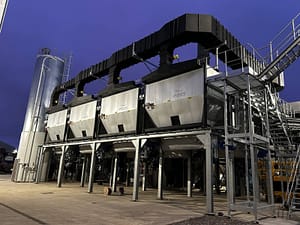
High-Temperature Filtration in Steel Production
Steel manufacturing, particularly electric arc furnace (EAF) operations, generates high-temperature gas streams containing fine particulate and process-derived dust. These emissions must be controlled to support environmental compliance and protect downstream equipment operating in demanding thermal conditions.
Filtration in steel production plays an important role in maintaining process stability. Dust carryover can contribute to fouling, increased wear, and reduced efficiency in downstream systems. As operating conditions fluctuate, filtration systems must perform reliably under varying temperature and dust loading profiles.
Hot gas filtration systems provide a dry solution that enables particulate removal directly at elevated temperature, reducing the need for gas cooling and simplifying the overall filtration train.
Dust Characteristics in EAF and Steelmaking Processes
Dust generated in steelmaking processes includes fine particulate with a broad particle size distribution, often extending into the sub-micron range. These dust streams are typically abrasive and may be present at high loading depending on the process configuration and operating conditions.
In high-temperature environments, spark carryover and hot particulate are also present, creating additional demands on the filtration system. This combination of temperature, particulate loading, and process variability requires filtration systems capable of maintaining stable performance without degradation.
Effective filtration must therefore provide high capture efficiency, thermal stability, and safe operation in demanding process conditions.
Limitations of Conventional Filtration Systems
Fabric bag filters are widely used in industrial dust collection, but their limitations become clear in high-temperature steel applications. Temperature constraints typically require gas cooling prior to filtration, increasing system complexity and creating the risk of condensation.
Condensation can lead to filter blinding, unstable pressure drop, and higher maintenance demand. In addition, spark carryover presents a fire risk in combustible filter media, often requiring added protection systems and increasing operational burden.
Frequent media replacement and increased maintenance intervention can reduce reliability and raise operating costs in continuous, high-temperature environments.
Ceramic Filtration for Steel and EAF Off-Gas
Ceramic hot gas filtration provides a reliable alternative for high-temperature steel applications. Systems operate continuously up to 750°C, with capability to 1000°C, allowing filtration to take place without gas cooling.
Ceramic filter media is non-combustible and resistant to thermal and chemical stress. Surface filtration enables effective capture of fine particulate, while pulse-jet cleaning maintains stable pressure drop during operation.
This supports consistent filtration performance under variable process conditions and removes common failure modes associated with combustible media.
Operational Integration and Performance Benefits
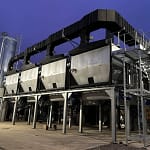
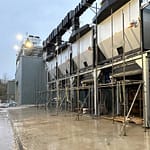
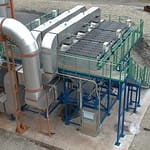
Ceramic filtration systems can be integrated into high-temperature exhaust systems across a range of steel production processes. Modular configurations allow adaptation to different plant layouts and operating requirements, supporting both retrofit and new-build installations.
Operational benefits include reduced maintenance frequency, elimination of filter fire risk, and improved protection of downstream equipment. Dry dust discharge simplifies handling and avoids the need for liquid waste treatment.
For steel manufacturing environments, ceramic filtration provides a stable and proven approach to high-temperature particulate control. Where application requirements vary, bespoke filtration systems can be configured to suit plant layout, gas volume, and operating temperature.