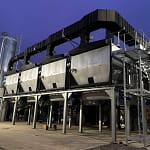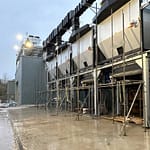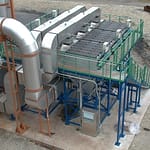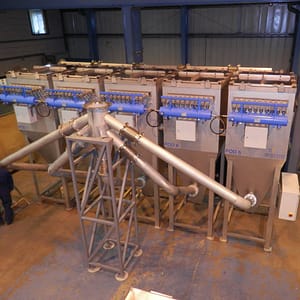




Environmental regulations for SO2, HCl, and particulate matter are becoming increasingly strict—particularly for high-temperature processes like incineration, gasification, and metallurgical operations. But while expectations are rising, so too are budgetary and spatial constraints. The challenge many engineers face is clear: how to deliver low emissions from hot gas streams without adding costly and complex infrastructure.
This article compares dry scrubbing hot gas using ceramic filters and sorbent injection with traditional wet scrubbing. It aims to help project teams weigh the pros and cons of each, based on real-world performance, maintenance, and practical suitability.
What Wet Scrubbers Do Well (and Where They Fail)
Wet scrubbers have long been used to neutralise acid gases such as SO2, HF, and HCl. Their basic principle involves cooling the gas and forcing it into contact with a liquid medium—typically water treated with chemical reagents. When it works well, this approach offers very high gas-phase removal efficiency. However, these systems come with considerable design and operational burdens.
Firstly, hot gas streams must be cooled prior to scrubbing, often with quench towers or dilution air systems. This adds energy demand and increases fan sizing, which in turn impacts layout and running costs. Second, scrubbers require bulk chemical storage and dosing infrastructure. This increases handling complexity, safety risk, and the need for operator supervision. Third, the result of wet scrubbing is a contaminated liquid effluent. This must either be treated in-house or hauled away under licensed disposal schemes—both of which can be expensive over time. Finally, wet scrubbers typically operate below 70°C, which makes them unsuitable for direct integration into high-temperature gas lines without major heat exchange or bypass logic.
How Dry Scrubbing Works with Ceramic Filters
Dry filtration takes a completely different approach. Instead of cooling the gas or introducing water, powdered sorbents such as sodium bicarbonate or hydrated lime are injected directly into the hot gas stream. These compounds react with acid gases to form dry salts. These salts, along with particulates like PM10 and PM2.5, are then captured on the surface of the filter elements. Ceramic filters—specifically extruded monoliths rated for 400–1000°C—serve as the capture surface.
The benefit of this configuration is that both particulate and gaseous pollutants are removed in one step, with no need for secondary wet or polishing stages. There are no liquids involved, so maintenance complexity is reduced and corrosion risks are minimal. More importantly, the system can operate at full gas temperature without the need for dilution or bypass cooling. This makes dry filtration ideal for biomass CHP, food waste incineration, and energy-from-waste plants where compact, high-temperature operation is essential.
Emission Performance – Real-World Numbers
Measured emissions from modern ceramic filter systems using dry scrubbing consistently show excellent results. Particulate matter levels—both PM10 and PM2.5—are routinely kept below 2 mg/m³. Hydrogen chloride (HCl) levels typically fall under 3 mg/m³, and sulphur dioxide (SO2) emissions can be reduced to below 20 mg/m³ with optimised sorbent dosing. These results not only comply with the Industrial Emissions Directive (IED) but also satisfy stringent planning requirements in urban and sensitive environments. Importantly, they are achieved without relying on flue gas reheating, water treatment systems, or secondary baghouse filtration units.
Maintenance, Downtime, and Operating Costs
Dry filtration systems offer significantly lower maintenance demands compared to wet scrubbers. With no moving liquids, there are no pumps, tanks, or heat exchangers to maintain. Corrosion is greatly reduced, since there is no acidic water to attack internal surfaces or pipework. Operators do not have to manage chemical storage or ensure compliance with liquid effluent disposal rules. Daily operations are limited to checking compressed air supply for pulse cleaning and emptying dry hopper waste as required. Filter elements, typically made from sintered ceramic, are designed for multi-year service life under normal operating conditions. Unplanned downtime is rare, and scheduled maintenance can often be completed without full shutdown.
When to Choose Dry (and When You Shouldn’t)
Dry filtration is an excellent choice in a number of common scenarios. Where gas temperatures exceed 350°C and space is limited, ceramic filters with dry scrubbing are often the only realistic option. In remote locations, or sites without wastewater infrastructure, the elimination of liquid handling is a major advantage. For operations seeking both acid gas and particulate removal in one unit, dry systems reduce complexity and commissioning time.
However, dry filtration is not always the best fit. In gas streams with very high humidity or large volumes of chlorine and mercury, sorbent consumption can rise sharply. In these cases, wet scrubbing or hybrid systems with upstream reagent injection and downstream polishing may offer better lifecycle value. Similarly, where sub-ppm level SO2 removal is required for odour control or stack decolourisation, wet absorbers may outperform dry systems, albeit with higher running costs.
Dry filtration using ceramic elements and dry sorbent injection offers a practical, cost-effective, and reliable alternative to wet scrubbing in high-temperature processes. With lower maintenance needs, fewer moving parts, and no liquid waste, these systems are particularly well-suited to space-constrained or decentralised installations. While wet scrubbers still have their place in highly specialised scenarios, the majority of modern thermal applications are now turning to dry filtration for long-term compliance, simplicity, and performance.