



In high-temperature processes that generate or handle carbon-rich materials — including tyre pyrolysis, carbon black production, graphite handling, or biomass gasification — filtration presents a significant technical challenge. Fine soot particles, sub-micron black carbon, and sticky hydrocarbon residues often overwhelm traditional filters, leading to blockages, fire risks, and excessive maintenance.
Ceramic hot gas filters offer a proven, robust solution for these difficult operating conditions. This article explores how ceramic filtration performs in soot-laden processes, what design features are critical to reliability, and how verified field applications demonstrate long-term emissions control even under the most abrasive and reactive conditions.
The Challenge of Carbon-Rich Filtration
Processes involving elemental carbon — particularly pyrolysis or carbon black production — generate a unique blend of hot gas and fine particulates. These include soot, volatile organic compounds, condensable tars, and unburned carbon particles that remain suspended at temperatures exceeding 600°C.
Unlike mineral dust, carbon particles are typically hydrophobic, electrically conductive, and chemically reactive. They tend to agglomerate and form cake layers that are difficult to dislodge. They can also be combustible under certain oxygen concentrations, posing safety concerns during backpulse cleaning or maintenance. These characteristics make filtration complex, especially when using bag filters or water-cooled cyclones.
Traditional fabric filters degrade quickly in these environments. The combination of high temperature, hydrocarbon vapour, and abrasive soot leads to shortened bag life, increased emissions, and frequent downtime for changeouts or cleaning.
Why Ceramic Filters Excel in Soot-Filled Systems
Ceramic filters provide a fundamentally different approach. Constructed from sintered alumina-silica or silicon carbide, they are non-combustible and highly resistant to both thermal shock and chemical attack. Most importantly, they operate at continuous temperatures up to 1000°C without degrading or absorbing hydrocarbon vapours.
These filters use surface filtration, meaning particles accumulate on the outer skin of the element rather than penetrating into the structure. This allows for controlled backpulse cleaning using compressed air, dislodging the accumulated soot layer while maintaining airflow and filter integrity.
In carbon black and soot-heavy systems, ceramic filters:
- Remove >99.99% of particulate mass, including PM2.5 and nanocarbon
- Resist thermal oxidation and flame exposure during upset conditions
- Maintain stable pressure drop even under high dust loading
- Eliminate the need for water-based cleaning or quenching
- Support continuous online operation with minimal downtime
This makes them ideal for tyre pyrolysis plants, activated carbon production, graphite handling, and other carbon-intensive applications.
Design Considerations for Carbon-Laden Gases
Filtration of black carbon demands more than just a durable element — it requires a system designed to manage flow, temperature, pulse pressure, and dust disposal.
To start with, the filter housing must be insulated to prevent condensation of tars or vapours that could cause blockages. Internal surfaces are often treated or polished to minimise build-up, and flow distribution plates ensure uniform gas entry across the filter bank.
Pulse jet cleaning must be precisely tuned. In soot-rich streams, too aggressive a pulse can cause re-entrainment or damage to collected dust cake. Conversely, weak pulses may fail to dislodge dense carbon layers. Most systems in these applications use high-frequency pulsing triggered by differential pressure setpoints — often between 110 and 140 mbar.
The dust discharge system also requires care. Fine carbon particles are cohesive and can bridge or cake in poorly designed hoppers. Discharge valves must handle fine, sometimes sticky material at elevated temperature. Some systems opt for rotary valves with nitrogen purging or inert gas blankets to eliminate the risk of ignition during discharge.
Real-World Application: Tyre Pyrolysis Emissions Control
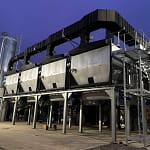
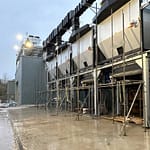
In a verified application, a tyre pyrolysis plant processing 2 tonnes per hour of shredded end-of-life tyres installed a Glosfume ceramic filtration system for control of soot and carbon particulate. The gas stream exiting the pyrolysis chamber reached 750°C and contained both solid black carbon and volatile condensables.
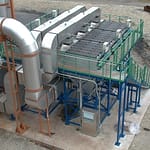
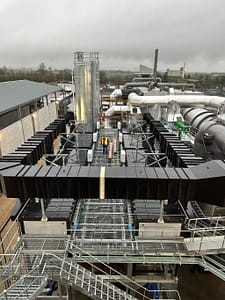
The filtration system consisted of a horizontal housing with 48 ceramic elements, designed for 7,500 m³/h nominal flow. Pre-filtration using a cyclone removed large ash and wire fragments, while the ceramic filters handled sub-micron soot and condensables.
Over 18 months of operation:
- Emissions were kept below 1 mg/m³ total PM
- Pressure drop remained within 100–125 mbar
- No ceramic element failures were recorded
- Compressed air consumption remained low due to DP-based pulsing
- Dust was discharged to sealed containers under inert conditions
The plant avoided wet scrubbers entirely, reduced maintenance, and retained a compact system footprint. This success demonstrates the value of high-temperature ceramic filtration in carbon-rich environments.
Combining Ceramic Filtration with Process Optimisation
While ceramic filters are resilient, they perform best when upstream process conditions are stabilised. This often includes managing:
– Gas velocity, to prevent soot bypass or element erosion
– Gas composition, keeping oxygen within safe operating limits
– Pre-filtration, such as cyclones or spark arrestors
– Temperature control, to avoid condensation and maintain efficiency
In well-engineered systems, ceramic filters integrate with renewable energy, syngas, or chemical recovery processes, particularly in modular skids or compact plants. Monitoring with thermocouples, pressure transmitters, and DP-based pulse control ensures consistency and lowers operational risk.
Other Industrial Applications Handling Black Carbon
Beyond pyrolysis, ceramic filtration has been applied successfully in:
- Carbon black manufacturing (post-furnace tail gas)
- Graphite and battery anode production
- Activated carbon regeneration kilns
- Plastic-to-fuel pyrolysis units
- Biomass combustion and wood tar gasification
These industries face similar challenges: high dust loading, reactive carbon particles, and minimal tolerance for system failures. Ceramic filters provide an efficient and modular solution with extended element life and low maintenance requirements.
Filtration of soot and carbon black at high temperature requires a filter system that can handle extreme particulates, avoid fire risk, and operate continuously without clogging or wet media handling. Ceramic filters meet these needs with high efficiency, durability, and flexibility.
With proper housing design, pulse control, and dust handling, ceramic filters enable long-term operation even in soot-rich environments like tyre pyrolysis and carbon processing. As emissions standards tighten and thermal processes become more decentralised, ceramic filtration offers a forward-looking, field-proven solution for clean, stable operation.