



Capturing acid gases like SO₂, HCl, and HF from hot process streams is essential for meeting environmental regulations and protecting downstream equipment. Traditional wet scrubbing systems have long been used in industry, but they come with drawbacks: large water usage, condensation issues, and added complexity in effluent treatment. In high-temperature operations — particularly those involving incineration, gasification, or metal processing — wet systems are increasingly being replaced by dry scrubbing combined with ceramic filtration.
This article explores how ceramic filters, when used in conjunction with dry sorbents such as sodium bicarbonate or hydrated lime, provide effective removal of acid gases from hot gas streams. We’ll also examine real-world data and outline system design considerations for engineers specifying or upgrading gas treatment systems.
Why Acid Gas Removal Matters in Hot Gas Environments
Acid gases are a common byproduct of combustion and thermal treatment of waste, biomass, plastics, and fuels containing sulphur or halogen compounds. If not neutralised, these gases can corrode ductwork, damage turbines, and poison catalysts. Additionally, emissions of SO₂ and HCl are tightly regulated in most jurisdictions, requiring reliable removal technologies that function under demanding conditions.
In high-temperature systems — such as those operating above 400°C — the options for acid gas removal become limited. Wet scrubbers are often ruled out due to their need to cool the gas stream, which creates water vapour, condensation, and large volumes of liquid effluent. In contrast, dry sorbent injection paired with high-temperature filtration allows acid gases to be neutralised in situ and removed as dry particulate, all without quenching the gas.
How Dry Sorbent Injection Works
Dry sorbent injection (DSI) involves dosing the hot gas stream with a powdered alkaline material. Common choices include sodium bicarbonate, trona, or hydrated lime. When injected at the correct location — typically upstream of the filter housing — these materials react with acid gases to form stable salts.
For example, sodium bicarbonate reacts with HCl to form sodium chloride (NaCl), which is collected downstream. It also reacts with SO₂ and SO₃, forming sodium sulphite and sulphate. The reaction kinetics are temperature-dependent, with optimal performance usually between 180°C and 350°C. However, the benefit of pairing DSI with ceramic filters is that it allows operation well above this range — often up to 700–800°C — because the sorbent and reaction products are captured as solid particulates without degrading the filter media.
Ceramic Filters Enable Combined PM and Acid Gas Removal
Ceramic filters are made from porous refractory materials and designed to capture fine particulates from hot gas. These ceramic filter elements are engineered for long service life, high-temperature resilience, and compatibility with dry sorbents. Their rigid, high-temperature construction allows them to operate continuously at temperatures up to 1000°C. When DSI is used, ceramic filters serve a dual function: they trap both the unreacted sorbent and the salt products of the acid gas reaction.
This simultaneous removal of dust and gas-phase pollutants is what gives ceramic filters an edge over traditional baghouses. Fabric filters typically degrade above 250–300°C and are incompatible with the high dust loads or backpulse pressures associated with DSI in hot environments.
In a properly designed system, ceramic filters remove fine dust and PM2.5 from combustion or gasification, the reacted salts formed by DSI (e.g. NaCl, Na₂SO₄), and any residual unreacted sorbent for later disposal or recovery. Pulse-jet cleaning keeps the filters clear without interrupting the process, and emissions can consistently be held below 1 mg/m³ for PM, and below permitted thresholds for SO₂ and HCl — often without a wet stage at all.
Verified Performance: Ceramic Filters and Sodium Bicarbonate
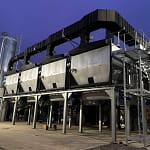
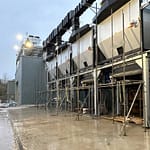
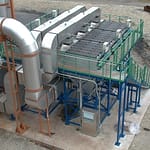
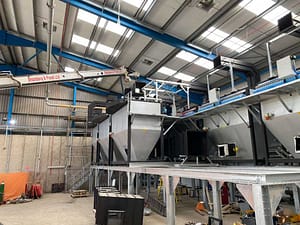
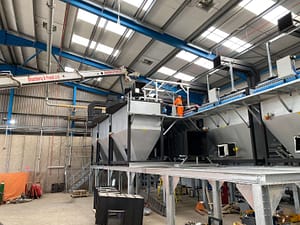
In verified installations treating waste-derived fuel and biomass combustion gases, Glosfume ceramic filtration systems have successfully integrated dry sorbent injection for acid gas control. Operating temperatures ranged from 500°C to 850°C. Sodium bicarbonate was injected upstream of the ceramic filter housing using a controlled dosing system. The filters, housed in modular horizontal vessels, achieved the following performance:
PM emissions were consistently below 1 mg/m³, while HCl and SO₂ removal efficiencies exceeded 95%. Sorbent injection rates were optimised to avoid excess carryover, and filter elements remained in service for over 30 months without replacement. These results confirm that ceramic filtration — combined with correctly managed DSI — offers a dry, robust, and low-maintenance alternative to traditional scrubbing methods.
System Design Considerations
To ensure effective acid gas capture, the design of the injection and filtration system must be integrated from the outset. Sorbent injection must occur far enough upstream to allow for sufficient reaction time but not so far that particles settle or cake before reaching the filters. Engineers typically locate the injection point between 1 and 3 seconds of residence time ahead of the filter housing, depending on gas velocity.
Gas mixing is critical. Incomplete mixing leads to unreacted gases slipping through. Systems often employ static mixers or turbulence-enhancing devices upstream of the injection point. Sorbent particle size and feed rate also affect performance — smaller particles provide faster reaction rates but may be more difficult to convey and handle.
The ceramic filter housing should be configured to handle the additional dust load from the reacted salts and unused sorbent. This includes increased hopper volume, larger pulse manifolds, and dust discharge equipment suited to dry alkaline powders. Housing materials should be selected to resist the slightly abrasive and potentially corrosive nature of the combined dust stream.
Glosfume regularly supports bespoke system design to suit these specific requirements — including compact housings, sorbent dosing integration, and pre-assembled filtration modules for easy installation.
It’s also worth considering that sorbent choice may be driven by the specific gas chemistry and regulatory limits. While sodium bicarbonate is effective and thermally stable, hydrated lime may be preferred where SO₂ is less prominent but HF or organic acid vapours are a concern.
Advantages Over Wet Scrubbing
Many older plants rely on wet scrubbers for acid gas removal, but the drawbacks are becoming more apparent. These systems require active cooling, water treatment, and often chemical dosing to control pH and scaling. In contrast, dry systems are simpler, require fewer utilities, and are easier to integrate into modular or containerised plants.
The key benefits of using ceramic filters with DSI include operation at full process temperature, no need for water or chemical tanks, no effluent handling, a compact layout, and simultaneous control of particulate and acid gas emissions. For applications like energy-from-waste, biomass gasification, or metals processing, these advantages are especially compelling — particularly where site space, water availability, or uptime requirements are strict.
Dry acid gas control using sorbent injection and ceramic filtration has emerged as a reliable, high-performance alternative to wet scrubbing in high-temperature industrial processes. By combining particulate capture with in-line gas neutralisation, ceramic filters allow operators to meet strict emissions limits while simplifying plant infrastructure.
With proven results in PM, SO₂, and HCl removal, and compatibility with operating temperatures up to 1000°C, this approach is ideal for modern combustion and thermal treatment systems. As environmental standards tighten and energy efficiency becomes a priority, dry ceramic filtration continues to offer a forward-looking solution that’s both practical and scalable.