



In many industrial and biomass installations, visible emissions—often seen as plume or fine ash fallout—pose serious regulatory and reputational challenges. Even when particulate emissions remain within legal limits, the presence of a visible stack plume can trigger complaints, delay planning approval, or attract regulatory scrutiny. Traditional mitigation involves introducing dilution air or stack reheating, but these solutions add complexity, energy cost, and infrastructure.
There is a cleaner way. High-efficiency filtration technologies, particularly ceramic systems, can eliminate visible particulate emissions at source—removing the need for dilution altogether.
Understanding the Cause of Visibility
Visible plumes are typically caused by submicron particulates (such as PM2.5), condensed organics, or moisture-laden gases that cool too quickly. Ash and fine char escaping from biomass combustion, or soot particles from oily feedstock, scatter light and form the tell-tale white or grey plume. These are often seen even when mass-based emissions meet regulatory limits.
Traditional bag filters may allow fine particles or volatiles to pass through, especially during startup or high-load conditions. Where combustion is variable or fuel is inconsistent, the chances of visible emissions increase substantially.
Why Dilution Is Not Ideal
Dilution systems add ambient air into the flue gas stream to reduce plume visibility by increasing exhaust temperature and reducing moisture saturation. While effective to a degree, this approach can lead to higher fan energy use, larger stack sizes, and increased complexity in ductwork and control systems. It also does not remove pollutants—only disperses them over a larger volume.
Furthermore, dilution does not address the root cause of emissions and can complicate compliance calculations based on normalised concentrations.
Preventing Visible Emissions at Source
A more robust approach is to eliminate the source of the visible plume.
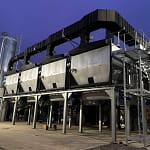
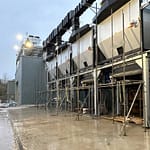
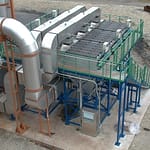
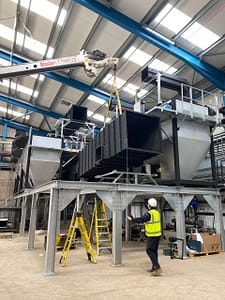
Ceramic filtration systems operate at high temperatures and are capable of capturing very fine particulates, including PM2.5 and sub-micron ash. These filters remove the bulk of the light-scattering particles directly from the gas stream before condensation can occur. Their ability to maintain stable capture efficiency regardless of load fluctuations is especially valuable in biomass and waste-to-energy systems.
For example, ceramic filters installed on biomass-fed commercial kitchens and boiler houses have demonstrated complete removal of stack fallout, allowing operations to continue in densely populated areas without visual disturbance.
Real-World Application
In a food waste CHP system serving a major hospitality venue, fine ash was settling on vehicles and buildings, prompting complaints. The introduction of a ceramic filtration system eliminated all visible emissions within days. Similarly, in a biomass heating plant adjacent to residential housing, visible plumes triggered delays in project commissioning. By deploying ceramic filters, the site gained local authority approval and began operation without further issue.
Benefits for Planning and Compliance
By removing visible emissions through filtration rather than dilution, operators simplify their compliance strategy. Systems remain more compact, avoid the need for extra fan capacity, and reduce long-term maintenance. Planning approvals in urban environments are easier to obtain when visual impact is demonstrably controlled at source. Local authorities and consultants increasingly expect projects to include technology capable of handling PM2.5 without resorting to stack reheating or tall discharge points.
Eliminating visible stack emissions improves environmental performance, reduces neighbour complaints, and simplifies permitting. Ceramic filtration provides a direct, energy-efficient route to achieve these outcomes without the drawbacks of dilution systems.