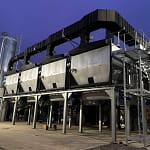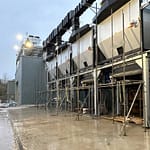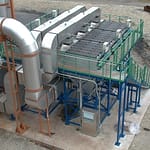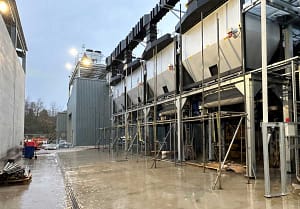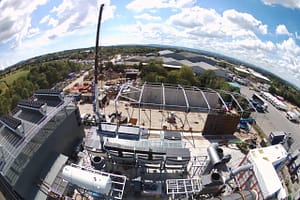




For many industrial combustion processes, controlling particulate matter alone is not enough. Emissions often include acid gases such as HCl, SO2, and HF, as well as dioxins and heavy metals. To meet environmental permits and safeguard public health, operators must remove both solid and gaseous pollutants. This is where the combination of ceramic filtration and dry scrubbing offers a highly effective, low-maintenance solution.
At Glosfume, we integrate these technologies into compact, self-contained systems that deliver ultra-low emissions for a wide range of industrial applications—from biomass and waste incineration to metal recovery and hazardous material processing.
How Dry Scrubbing Works
Dry scrubbing involves injecting powdered sorbents—typically sodium bicarbonate, hydrated lime, or activated carbon—into the flue gas stream before filtration. These reagents chemically react with acidic gases, neutralising them into inert salts. Activated carbon, in particular, adsorbs volatile organic compounds and dioxins, reducing total organic carbon (TOC) and toxicity downstream.
The reaction products, along with the original sorbent and unburnt particles, are then captured on the outer surface of the ceramic filters. This simultaneous removal of solids and gas-phase pollutants means a single system can achieve multi-contaminant compliance without requiring a wet scrubber or additional stages.
Advantages of Integrated Systems
Combining ceramic filtration with dry scrubbing in one housing offers several advantages. It eliminates the need for separate scrubbing towers, quenchers, or cooling ductwork. Because Glosfume ceramic elements operate at temperatures up to 1000°C, they handle hot gases directly, avoiding dilution or energy loss. Our systems are engineered for even reagent distribution, ensuring that each filter receives the correct sorbent exposure.
This approach minimises footprint, simplifies installation, and reduces ongoing maintenance. By integrating scrubbing and filtration, operators gain a compact system with fewer moving parts, lower consumables, and minimal water usage—ideal for remote sites or areas with limited access.
Application in Hazardous Waste and Biomass
In carcass incineration, for example, the process releases acid gases and odorous compounds alongside fine ash. Glosfume systems have been deployed in DEFRA-approved plants where sodium bicarbonate and activated carbon are injected prior to our ceramic filters. This configuration allows operators to meet strict emission limits for PM, HCl, SO2, and dioxins—all within a single enclosure.
Similarly, in biomass CHP systems where wood fuel may contain chlorine, dry scrubbing with sodium bicarbonate neutralises acidic off-gases before they reach the ceramic elements. The result is cleaner air, lower corrosion risk, and reduced plume visibility at the stack—making compliance easier in urban and sensitive zones.
System Monitoring and Maintenance
To maintain performance, Glosfume systems include real-time monitoring of pressure drop, reagent feed rate, and element cleaning cycles. Our PLC interface tracks when reagent injection occurs and logs cleaning pulses triggered by differential pressure thresholds. This ensures sorbent use is optimised, emissions stay low, and maintenance can be planned proactively.
Ceramic elements are durable and can operate for several years with minimal degradation. Spent sorbent and reaction salts are collected in hoppers below the filter for easy removal and safe disposal, without the need for liquid handling or complex waste treatment.
By combining ceramic filters with dry scrubbing technology, Glosfume delivers a comprehensive air pollution control solution in a single, efficient system. Whether the goal is to meet EU Industrial Emissions Directive limits, reduce visible plume, or gain local planning permission, this approach simplifies compliance and reduces operational complexity.