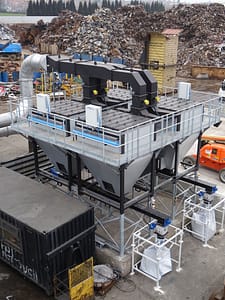




In any hot gas filtration system, pressure drop is more than just a metric—it’s a constant balancing act. Too high, and fans must work harder, increasing energy consumption and wear. Too low, and filtration may become ineffective or unstable. Maintaining the right differential pressure is key to both operational efficiency and particulate capture. This becomes particularly important in ceramic systems operating at high temperatures and with fine dust loading.
This article explores how modern ceramic filtration systems maintain low pressure drop while achieving emissions below 1 mg/m³—without sacrificing uptime, cleaning effectiveness, or filter life.
Understanding Pressure Drop in Ceramic Filtration
Pressure drop across a ceramic filter is primarily influenced by the element’s geometry, the filter cake, and the rate of particulate accumulation. Unlike bag filters, where media depth and permeability vary, ceramic filters rely on surface cake formation. This means that once the cake develops, the system must regularly clean it to prevent rising resistance.
In most ceramic systems, a well-balanced pressure range is between 15–25 mbar. Too low, and there isn’t enough cake to capture sub-micron particles. Too high, and fans are overworked, increasing cost and reducing lifespan. The key is maintaining consistent cleaning intervals, even gas flow, and well-designed pulse systems.
What Causes Pressure Drop to Creep Up?
Several operational factors can cause the differential pressure to rise. If the pulse cleaning system isn’t functioning correctly—due to solenoid failure, inadequate compressed air supply, or poor pulse frequency—dust cakes can harden or overbuild, leading to elevated resistance. Similarly, uneven gas distribution across elements may cause some filters to load more heavily than others.
Gas composition also plays a role. Sticky, oily, or condensable particles can form compacted cakes that are more difficult to dislodge. In these cases, cleaning logic may need adjustment, or the system may require preheating, insulation, or reagent injection to stabilise dust behaviour.
Design Features That Keep Pressure Stable
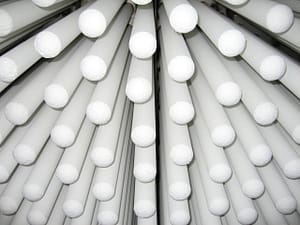
Ceramic filtration systems are designed with pressure management in mind. Element design—such as length, wall thickness, and porosity—is selected to match the expected dust load and gas flow. Glosfume’s G3 and S4 ceramic elements are engineered for consistent porosity and mechanical strength, which prevents micro-cracking and internal clogging over time.
Pulse systems use compressed air or nitrogen to deliver reverse bursts at regular intervals. The nozzle plate and pulse tube geometry are optimised to create a shock wave that detaches the cake without damaging the element. Control panels allow pressure thresholds to be set, so cleaning is triggered only when necessary—not simply on a fixed timer.
Housing design also matters. Smooth gas distribution, avoidance of eddies or dead zones, and correct hopper angles all reduce the likelihood of bridging or uneven loading—both of which contribute to higher pressure drop over time.
Case Example: Biomass Plant with Variable Load
At one biomass CHP installation handling mixed wood and food waste, ceramic filters were installed to handle gas at 850°C. Initial trials showed differential pressure rising above 30 mbar within days. After adjusting the pulse interval from 45 to 30 seconds and slightly increasing compressed air pressure, pressure stabilised between 18–22 mbar. As a result, fan load decreased, cake stability improved, and filter replacement intervals extended to over two years.
How Pressure Drop Impacts Efficiency
A stable pressure drop contributes directly to filtration performance. When filters operate in their optimal pressure range, they build and shed the correct thickness of filter cake, ensuring reliable PM2.5 capture and reduced emissions variability. Systems operating with excessive pressure may see filter fatigue, unplanned maintenance, and fluctuating outlet emissions.
Conversely, underloaded systems—where pressure drop never reaches cleaning thresholds—can suffer from inadequate cake formation. In such cases, capture efficiency suffers, especially for nano-sized particles or condensables. The result: lower emissions performance, despite the appearance of smooth operation.
Keeping pressure drop low—but not too low—is a core design and operational goal for high-temperature filtration. Through smart element selection, pulse cleaning design, and real-time pressure monitoring, ceramic systems can run with consistent pressure and deliver high-efficiency particulate control.
For engineers designing or operating hot gas systems, managing pressure drop is about more than air velocity. It’s about lifecycle cost, filter longevity, and ensuring environmental compliance without compromise.