



The shift towards circular economy models is accelerating across energy, metals, and process industries. Reducing waste, recovering materials, and designing for reusability are no longer optional — they are central to economic and environmental strategy. One critical but often overlooked component of this transition is industrial gas filtration. In particular, ceramic hot gas filters are proving vital in making recovery-focused and closed-loop operations technically viable — especially in harsh, high-temperature environments.
This article explores the role of ceramic filters in enabling circular economy outcomes, from minimising waste to recovering product value and supporting low-maintenance, resource-efficient systems.
From Linear to Circular: Why Filtration Is a Strategic Lever
In linear systems, filtration is often seen as an end-of-pipe necessity — something added to meet environmental regulations. In contrast, circular systems treat filtration as a design parameter. The ability to filter reliably at high temperatures and capture fine particulates without damaging material value is central to recovering metals, carbon residues, or mineral-rich dusts for reuse or sale.
By using dry ceramic filtration, operators can separate valuable particulates cleanly, avoid water-based scrubbing, and maintain product integrity — even in processes running at 700–1000°C. This opens up opportunities not only for emissions reduction, but also for material recovery and reuse that traditional filtration cannot support.
Capturing Value, Not Just Preventing Pollution
Ceramic filters are not just removing pollutants — they’re enabling the capture of marketable materials. Consider applications such as:
- Metals and mining: Recovery of zinc, copper, or nickel oxides from smelting off-gas.
- Battery recycling: Separation of active metal compounds from gas streams in thermal treatment processes.
- Biomass and waste combustion: Capture of char, fly ash, and other mineralised residues that can be reused as soil amendment or fuel additive.
In these cases, water-based filtration or fabric bags often contaminate the material or cannot handle the temperature. Ceramic filters make dry, clean separation possible — turning what was once pollution into a recoverable resource.
Durability That Supports Circular Operations
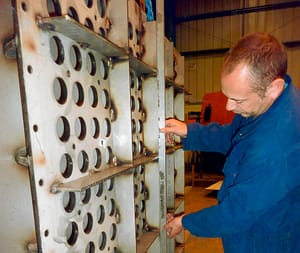
Process plants focused on sustainability need filters that last. Glosfume’s ceramic elements, including the G3 and S4 ranges, are designed for extreme temperatures and long-term performance. With resistance to thermal shock, chemical attack, and spark-induced damage, these filters often remain in service for 2–5 years with only routine backpulse cleaning. Their non-combustible nature also supports high uptime and safer operations — reducing system downtime, maintenance cost, and material waste.
Because ceramic filters do not rely on fibre-based media, there is no shedding or media loss during operation, making them ideal for sensitive downstream recovery systems or processes that demand high-purity gas output.
Case Study: Ash Recovery in Waste Wood Combustion
In a plant treating 8,000 m³/h of waste wood combustion gas at 850°C, Glosfume ceramic filters replaced a legacy wet scrubbing system. The ceramic system reduced particulate emissions to below 1 mg/m³ and enabled the dry recovery of over 90% of fly ash, which was reused as a mineral feedstock. Filter element life exceeded 36 months without replacement, and the system operated entirely without water or chemicals — aligning perfectly with circular and sustainable goals.
This case highlights the triple benefit: clean emissions, recoverable solids, and reduced operational burden.
Enabling Future-Ready Process Design
As industries move toward electrified heat, decentralised generation, and waste-to-product models, system designers are increasingly integrating dry ceramic filtration from the outset. These systems enable plants to:
- Eliminate effluent water handling
- Recover and reuse process dusts
- Maintain performance through variable feedstocks and thermal cycling
- Avoid recurring filter replacements and OPEX volatility
In short, ceramic filters are not an add-on — they’re becoming part of how circular process flows are engineered from day one.
Circular economy models require more than vision — they demand robust, durable systems that enable recovery, reuse, and long-term environmental compliance. Ceramic hot gas filtration delivers on all three. By capturing usable materials, reducing consumables, and operating cleanly at high temperatures, ceramic filters make sustainable process design a reality. For operations aiming to move from end-of-pipe control to in-process value recovery, they are an indispensable part of the solution.