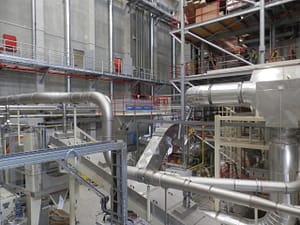




Flue gas treatment systems are used to control emissions generated during combustion and other high-temperature industrial processes in plants, incinerators and energy-from-waste facilities.
For Glosfume, the emphasis is on hot gas filtration at elevated temperatures, where conventional bag filters can struggle with sub-micron particulate, aggressive gas chemistry and thermal limits.
In these duties, effective filtration is not simply about compliance at the stack. It is also about maintaining stable operation, protecting downstream performance and avoiding emissions control becoming a constraint on plant availability.
From incinerator duties to flue gas treatment in waste to energy plants, systems must continue to perform under changing temperatures, variable gas compositions and continuous production cycles.
Effective hot gas filtration and dry scrubbing are therefore central to long-term operational stability in these applications.
In practice, good treatment design balances particulate capture, reagent efficiency, temperature capability, maintenance access and dependable cleaning performance.
What Is Flue Gas Treatment?
Flue gas treatment is the process of reducing pollutants in exhaust gases before discharge to atmosphere.
In the kinds of high-temperature applications Glosfume serves, this commonly means removing particulate matter and, where required, reducing acid gases through dry scrubbing.
The polluted gas stream may come from waste incineration, biomass combustion, thermal oxidation, product recovery or a wide range of other industrial processes.
Flue gas refers to the exhaust gases produced by combustion or thermal processing.
These gases can contain fine particulates, acid gases such as hydrogen chloride (HCl), hydrogen fluoride (HF) and sulfur dioxide (SO2), and in some duties dioxins and other contaminants.
Without treatment, these emissions can create environmental and regulatory problems, which is why filtration and reagent-based abatement are applied before discharge.
What Pollutants Are Removed in Flue Gas Treatment?
Particulates
Particulate matter consists of fine solid particles generated during combustion and thermal processing, including ash, metal oxides and other residues.
In many hot gas applications the particulate fraction is sub-micron, which is one reason conventional filters can be unsuitable.
Glosfume’s hot gas filtration systems are designed to capture very fine particulate at elevated temperature, with emissions below 3 mg/m3, typically 1 mg/m3, and in some trials substantially lower.
In biomass applications, particular attention is often given to PM10 and PM2.5, including sub-micron particulate that is not visible to the naked eye.
Glosfume describes ceramic filter elements with a micro-porous surface finish developed to trap these finer particles effectively.
Performance depends not only on the element itself, but also on stable gas flow, controlled cleaning and correct system design.
Sulfur Dioxide and Sulfur Oxides (SO2)
Sulfur dioxide and related sulfur oxides are acidic combustion products that may require treatment before discharge.
In Glosfume dry scrubbing applications, pollutants such as SO2 can be neutralised using sodium bicarbonate or lime.
The reaction performance depends on reagent choice, injection quality, gas temperature and how effectively the reacted material is retained on the filter surface.
Nitrogen Oxides (NOx)
Nitrogen oxides are a recognised combustion pollutant and may need separate control measures depending on the plant and permit.
Glosfume’s strongest fit in this area is hot gas particulate filtration and dry scrubbing support, especially where fine particulate and acid gases need to be managed at elevated temperature.
Heavy Metals (Including Mercury)
Certain combustion and thermal processes can release trace contaminants that must be captured before discharge.
Activated carbon can be used within dry scrubbing applications alongside hot gas filtration.
Where such absorbents are used, the resulting solids are retained on the filter elements and removed during cleaning as part of the filter cake.
Dioxins and Acidic Gases
Acid gases such as HCl, HF and SO2, together with dioxins in relevant duties, can be treated by dry scrubbing using sodium bicarbonate or lime together with activated carbon.
Glosfume filters are designed to function efficiently and reliably over the important dry scrubbing range of 140°C to 450°C.
Removing HCl at temperatures above 400°C also helps prevent the reformation of dioxins, which is one of the practical advantages of high-temperature treatment.
Carbon Dioxide (Emerging Capture Approaches)
Carbon dioxide is a combustion product, but carbon capture is separate from Glosfume’s hot gas filtration focus.
This page is therefore focused on particulate removal, dry scrubbing of acid gases and related pollutants, and the contaminants Glosfume directly addresses through its filtration technology.
How Flue Gas Treatment Works (Process Overview)
A practical way to understand Glosfume’s approach is as a staged process combining reagent injection, filtration and solids removal.
Although plant layouts vary, the principle remains straightforward: pollutants are presented to the gas stream, captured on the filter surface and then removed by controlled cleaning.
The aim is to achieve dependable emissions performance at temperature without introducing unnecessary complexity into the plant.
Stage 1 – Gas Abatement (Reagent Injection)
In dry scrubbing duties, reagents are injected into the hot gas stream upstream of the filtration stage.
Glosfume systems can be specified with sodium bicarbonate, lime and activated carbon for the treatment of acid gases, dioxins and related contaminants.
The objective is to ensure the absorbent is properly dispersed and carried to the filter elements, where the reaction and capture process can continue efficiently.
Temperature matters greatly at this stage.
Sodium bicarbonate remains fully active across the 140°C to 450°C range used in Glosfume systems, with no variation in consumption across that band.
Complete filter units are modelled so pollutants are presented uniformly across the elements and the absorbent is drawn onto the surfaces where reaction takes place.
Stage 2 – Particulate Removal (Filtration)
Following reagent injection, the gas stream enters the filtration stage.
As the polluted gas passes through the filter elements, particulate and reacted scrubbing products are retained on the outside surface while clean gas passes through to the clean side and is discharged.
Over time, this retained material forms a filter cake that contributes to capture efficiency.
In high-temperature applications, ceramic filter elements provide a robust solution where conventional bag filters can fail because of temperature, acid attack, alkali attack or heavy sub-micron loading.
Glosfume ceramic and mineral elements are designed to withstand much higher temperatures than conventional bag filters and are suited to sub-micron particulate capture.
As the differential pressure rises, the elements are cleaned by automatic reverse pulse cleaning, discharging the collected cake to the base of the housing for removal.
Stage 3 – By-Product Handling (APCR)
Once particulate and reacted scrubbing products have been removed from the gas stream, the collected solids must be handled reliably.
In Glosfume systems, this material falls to the bottom of the housing and can then be removed manually via a collecting tray or automatically using a screw conveyor, depending on the system arrangement.
That solids handling stage is an important part of keeping the filtration unit stable in service.
Where dry scrubbing is used, the collected residue will include captured particulate together with spent or partially spent reagent.
Sodium bicarbonate can also offer a practical handling benefit: a proportion converts to gas, which means less solid material is sent to landfill than with lime-based operation.
That can be a useful consideration where disposal volumes and environmentally responsible handling matter.
Flue Gas Treatment Approaches: Wet vs Dry vs Semi-Wet
Wet Process
Wet flue gas treatment systems use liquid scrubbing to absorb pollutants from the gas stream.
They are part of the wider emissions-control field, but they are a different treatment route from Glosfume’s hot gas filtration and dry scrubbing focus.
Wet systems are therefore best understood separately from the hot gas filtration approach described on this page.
Dry Process
Dry flue gas treatment is the approach most closely aligned with Glosfume’s hot gas filtration systems.
In this arrangement, dry reagents such as sodium bicarbonate, lime and activated carbon are introduced into the gas stream and the resulting particulate is captured by high-temperature filter elements.
This method is particularly relevant where operators want to avoid the temperature limitations of bag filters and maintain filtration performance at elevated process temperatures.
Semi-Wet Process
Semi-wet systems sit between wet and dry methods and are used in some parts of industry.
However, they should not be treated here as a defined Glosfume specialism.
Glosfume’s strength in this context is high-temperature dry filtration and dry scrubbing.
System Components and Plant Integration
Filters and Baghouse-Style Filtration (Example Configurations)
For Glosfume applications, the filtration stage is built around hot gas filter elements rather than relying on conventional baghouse fabrics.
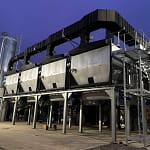
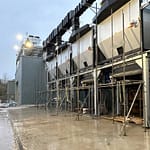
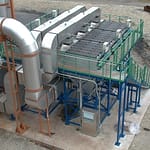
Glosfume supplies modular systems in standard pod sizes which can be linked together to create larger units with considerable flexibility in layout and performance.
One of the practical advantages of this modular arrangement is that individual modules can be shut down for maintenance without closing the whole process, helping operational continuity.
The reason is practical.
Conventional bag filters are described as having poorer thermal durability, being flammable, being vulnerable to acids and alkalis below dew point, and typically operating at much lower temperatures.
By contrast, Glosfume’s ceramic and mineral elements are designed for demanding high-temperature duties and sub-micron particulate capture.
Scrubbers and Reagent Systems
Reagent systems in the Glosfume context are designed to store, meter and inject dry absorbents into the gas stream in a controlled way.
Glosfume dry scrubbing chemistry can use sodium bicarbonate, lime and activated carbon, depending on the pollutants to be reduced.
Accurate dosing and good dispersion are important because poorly presented reagent will underperform even where the chemistry is otherwise suitable.
Sodium bicarbonate is particularly relevant in conjunction with Glosfume filters.
Unlike conventional bag filter systems which have a narrower useful operating range, sodium bicarbonate remains fully active between 140°C and 450°C in Glosfume’s high-temperature dry scrubbing arrangements.
That temperature flexibility is one of the reasons the combination is so strong.
Activated Carbon / Adsorption for Specific Pollutants
Activated carbon is used in relevant duties where adsorption is needed alongside particulate filtration and dry scrubbing.
Activated carbon may be used with sodium bicarbonate and/or lime where pollutants such as dioxins and acid gas-related contaminants are being controlled.
Once introduced upstream, the absorbent is retained on the filter elements as part of the active cake layer and then removed during cleaning.
Monitoring and Control Systems
Glosfume systems can include PLC and touch-screen-based controls used to maintain accurate process control.
The stated functions include pressure regulation, parameter monitoring, data logging for traceability, password-protected settings and remote monitoring capability.
In practice, these control features help the system maintain steady suction, support cleaning performance and provide operators with a clearer picture of plant behaviour over time.
Case Example: Energy-from-Waste (EfW) Flue Gas Treatment
Example System Layout and Operating Practices
A representative Glosfume arrangement for energy-from-waste or incineration duty is better described in modular terms than by fixed baghouse counts.
HTMC modules can be linked together to create systems of substantial size, while still allowing individual modules to be isolated for maintenance.
That modularity is valuable in continuous plant operation because it supports flexibility, easier transport and installation, and better maintenance planning.
The same principle applies operationally.
Hot gas passes from the dirty side through the filter elements into the clean side, while particulate and reacted reagent collect on the outer element surfaces.
Automatic reverse pulse cleaning then removes the build-up as filter cake, allowing emissions performance to be sustained without constant manual intervention.
By-Products and Hazardous Waste Handling
In dry scrubbing and filtration duties, the collected solids consist of process particulate together with reacted absorbent.
APCR handling should be designed around the specific process, waste classification and site requirements, so it is best not to overstate a single Glosfume-specific handling route.
The key point is that removed material is discharged from the housing and must be handled as part of the plant’s normal solids management arrangement.
Environmental and Safety Considerations
Handling Lime, Carbon, and Other Reagents
Dry reagents such as lime, sodium bicarbonate and activated carbon must be handled carefully to maintain both safety and performance.
Good practice includes keeping materials dry, maintaining reliable feed arrangements and preventing poor flow or inconsistent dosing.
From an engineering point of view, reagent quality and presentation are directly linked to abatement efficiency, so storage and dosing should never be treated as an afterthought.
APCR Storage, Transport, and Disposal
Where dry scrubbing residues are generated, they must be removed from the plant in a controlled and practical manner.
Glosfume systems focus on collection from the base of the housing and onward handling rather than prescribing a single disposal specification.
The key operational point is that solids removal should be dependable, contained and properly integrated with the filtration process so the plant can continue to run steadily.
FAQs
What is used to remove flue gas?
Flue gas itself is not removed, but pollutants within it are reduced before discharge.
In Glosfume’s dry filtration approach, this is done using high-temperature filter elements together with dry scrubbing reagents such as sodium bicarbonate, lime and activated carbon.
The exact arrangement depends on the process, the temperature and the contaminants present in the gas stream.
What are the different types of flue gas treatment?
Across industry, flue gas treatment may be wet, dry or semi-wet.
Glosfume’s specialism is the dry, high-temperature route, combining hot gas filtration with dry scrubbing.
That makes it particularly relevant where operators need strong particulate capture and acid gas reduction without relying on conventional bag filters at lower temperatures.
Why is flue gas treatment important?
Flue gas treatment is important because it reduces harmful emissions before they reach the atmosphere.
In practical plant terms, it also allows high-temperature processes to continue operating while staying within emissions limits.
For Glosfume applications, that means dependable capture of fine particulate and associated pollutants under demanding operating conditions.
Is flue gas harmful to humans?
Untreated flue gas can contain particulate, acid gases and other pollutants that are harmful if released without proper control.
That is why filtration and dry scrubbing are applied before discharge.
The objective is to reduce emissions to acceptable levels while maintaining reliable plant operation.
What is the use of flue gas?
Flue gas is the exhaust stream produced by combustion or thermal processing.
Although heat recovery may be possible in some plant designs, the gas still requires treatment where pollutants are present.
The need for treatment does not disappear simply because energy recovery is part of the wider process.
What is APCR?
APCR is a term commonly used for the solid residue produced during dry flue gas treatment.
In practical terms, it consists of collected particulate together with reacted or unreacted absorbent materials captured by the filtration stage.
For this page, the important point is that the solids removed by the filter system must be handled reliably as part of the overall process.
Speak to an Expert
If you are reviewing flue gas treatment requirements for an incinerator, industrial plant or waste-to-energy facility, it is worth starting with the gas temperature, particulate characteristics and whether acid gas reduction is required alongside filtration.
For high-temperature duties, the choice of filter media and the interaction between dry scrubbing chemistry and the filter cake are often decisive.
If you would like to discuss system design, filtration selection or integration considerations, our team can provide specialist guidance.
Contact Glosfume to discuss your emissions control requirements.