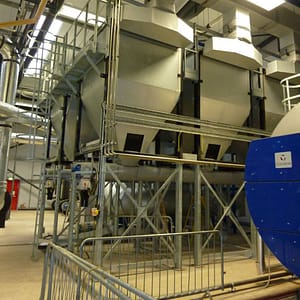




As industrial processes become more decentralised, there’s growing demand for mobile and containerised filtration systems that deliver full emissions compliance in a compact, modular format. Whether it’s for distributed energy, pyrolysis units, or portable waste incineration, the filtration system must be high-performing, low maintenance, and designed to fit inside tight spaces—often with no water handling and minimal operator input.
This article outlines how ceramic filtration technology is adapted to meet these requirements, and why it’s fast becoming the go-to solution for containerised and small-footprint installations.
The Challenge of Emissions Control in Compact Systems
Traditional filtration systems—like baghouses and wet scrubbers—were designed for permanent installations with generous footprint, utility connections, and access. In mobile or prefabricated plant formats, these assumptions no longer hold. The system must be:
- Fully self-contained
- Dry-operating (no liquid waste)
- Low energy and maintenance
- Robust under thermal cycling and vibration
- Capable of meeting PM2.5, acid gas, and visibility limits
Bag filters struggle above 300°C, and wet systems require tanks, drains, and chemical dosing—all of which complicate mobile deployment. Ceramic filters offer a way around this.
How Ceramic Filtration Enables Compact Emission Control
Ceramic filters operate dry, with pulse-jet cleaning and no moving parts inside the filtration module. They tolerate temperatures from 400–1000°C, capture particulates down to PM2.5, and support integrated sorbent injection for acid gas removal—all in a single vessel.
Because they don’t rely on bag tension, airflow from below, or frequent media changes, ceramic filters are well suited to pre-mounted or skid-based installation. Units can be designed as plug-and-play modules with access ports, clean gas outlets, and dust hoppers sized for periodic emptying rather than continuous flow.
Designing for Mobility and Reliability
In mobile units, vibration resistance and cleaning efficiency are key. Ceramic elements are fixed in place, with no sagging or mechanical wear over time. Pulse systems can be operated via on-board compressors or external hookups, with logic programmed to respond to differential pressure rather than a fixed timer—optimising energy use.
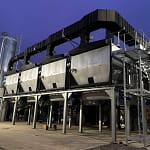
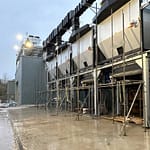
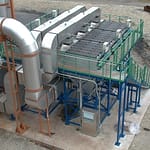
Compact ceramic filter housings are typically steel-clad and insulated, with integrated nozzle bars and access doors. Mounting configurations range from single-row systems for flows around 500 m³/h to multi-row modules up to 6,000 m³/h in containerised format.
Real-World Applications
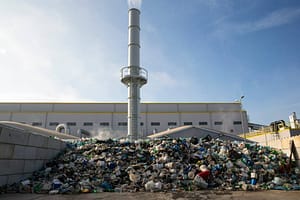
Glosfume has delivered containerised ceramic filters for mobile animal waste incinerators, compact pyrolysis plants, and decentralised bioenergy systems. These systems meet strict planning and environmental regulations, offering near-zero visible emissions and sub-1 mg/m³ particulate levels—without the infrastructure demands of wet scrubbing or external ducting.
Some units are even designed for periodic relocation, enabling contractors or project developers to move assets between temporary sites without violating local emissions thresholds.
Conclusion
Containerised ceramic filtration offers a compact, reliable, and compliant solution for mobile process systems. It brings industrial-grade emissions performance into a format that fits standard 20- or 40-foot enclosures, making it ideal for modular energy, waste treatment, or chemical processes operating at high temperatures and tight tolerances. With no water, minimal operator input, and long service life, it’s a filtration approach built for modern, flexible operations.