



Per- and polyfluoroalkyl substances (PFAS) and persistent organic pollutants (POPs) represent one of the greatest environmental challenges facing regulators and waste processors today. These “forever chemicals” resist conventional treatment and must be destroyed at high temperatures — often through thermal oxidation or high-temperature incineration.
But destruction is only one part of the problem. Containing the resulting emissions, including sub-micron particulate, acid gases, and trace metals, is equally critical. Ceramic filtration systems have emerged as a trusted solution in PFAS and POPs treatment projects — offering dry, high-temperature filtration with the ability to capture fine contaminants safely and consistently.
Why PFAS and POPs Require Advanced Filtration
When incinerated or oxidised, PFAS compounds break down into smaller fluorinated molecules, some of which can be corrosive, reactive, or toxic. POPs — such as dioxins, furans, and PCBs — behave similarly, forming complex gas-phase and particulate emissions.
Filtration systems used in these applications must meet the following criteria:
- Withstand temperatures of 850–1000°C
- Capture PM2.5 and ultrafine particles
- Resist chemical degradation and corrosion
- Operate continuously with minimal maintenance
- Prevent re-entrainment or cross-contamination
Conventional bag filters and wet scrubbers are often inadequate. The risks of filter fires, incomplete removal, or contaminated wastewater streams make them unsuitable for high-integrity PFAS and POPs destruction systems.
PM2.5, Acid Gases, and Metals from PFAS Combustion
PFAS thermal treatment produces a mixture of combustion by-products:
- Fine particulate containing fluorinated ash or carbonaceous residue
- Acid gases such as HF and HCl
- Trace metals including chromium, arsenic, and mercury
Because many PFAS-containing wastes are co-treated with other industrial residues, the gas composition can vary widely. Filtration systems must therefore be resilient, adaptable, and stable — capable of delivering sub-milligram-per-cubic-metre performance even under load fluctuations.
Ceramic elements provide a surface filtration mechanism that traps particulate before it leaves the housing, while operating at temperatures high enough to prevent dioxin reformation — a key advantage over cooled systems.
Ceramic Filters at 850–1000°C
Glosfume ceramic filters are designed for continuous duty at temperatures up to 1000°C. Made from non-combustible, corrosion-resistant ceramic fibre and bonded using advanced techniques, these filters can capture:
- PM2.5 and nano-scale dust
- Metal oxides and salts
- Reaction by-products from neutralisation reactions
Combined with dry sorbent injection — typically sodium bicarbonate or lime — ceramic filters enable efficient removal of acid gases and particulates in a single housing, with no need for water or secondary scrubbing.
Backpulse cleaning maintains performance, and filter elements often last over two years in operation without changeout. Housings are modular and can be customised for pilot-scale or full-scale PFAS destruction systems.
Case Reference: Pilot PFAS Treatment Plant
In a recent European demonstration project, a pilot-scale thermal oxidation unit for PFAS-contaminated materials was fitted with a ceramic filter system. The plant processed 1,500 m³/h of flue gas at 870°C, containing a mix of fluorinated compounds, fine ash, and trace metals.
The filtration unit featured:
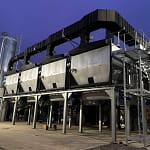
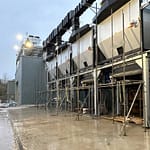
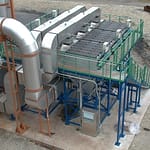
- 18 ceramic filter elements in a compact, insulated housing
- Automated pulse-jet cleaning with pressure monitoring
- Sodium bicarbonate injection upstream for HF control
- Full data logging of emissions and pressure drop
Results showed:
- PM emissions < 1 mg/m³ across multiple feed types
- HF emissions < 3 mg/m³ without any quenching
- Stable operation during batch and continuous modes
- Zero downtime for filter maintenance during 12-month trial
These outcomes helped validate ceramic filtration as a viable option for commercial PFAS destruction units now under design.
Dry Filtration vs Wet Systems
Wet scrubbing systems have been used in POPs and PFAS treatment, but they come with significant drawbacks:
- Need for quenching, which may reduce combustion efficiency
- Generation of contaminated wastewater requiring further treatment
- Risk of dioxin reformation in cooler zones
Dry ceramic filtration avoids these issues. By keeping gas temperatures high through the filtration step, operators maintain better destruction efficiency and avoid introducing new waste streams.
Additionally, ceramic filters eliminate fire risks, reduce footprint, and simplify emissions reporting — all key advantages for compliance and permit approval.
Thermal treatment of PFAS and POPs is growing rapidly as regulators demand safe, final destruction of persistent pollutants. But destruction alone is not enough — emissions must be controlled to the highest standards.
Ceramic filtration provides a proven, dry, and durable method for capturing PM2.5, acid gases, and reaction by-products at high temperatures. With minimal maintenance and no water use, it’s an ideal choice for facilities seeking long-term reliability and environmental assurance in POPs and PFAS combustion.