



As air pollution continues to dominate global environmental agendas, the reduction of fine particulate emissions—specifically PM10 and PM2.5—has become increasingly vital for industries that release hot gases as a by-product. These tiny airborne particles, often generated in high-temperature processes such as biomass combustion, incineration, and metal recovery, present serious health and environmental risks. Their control is not only a matter of regulatory compliance but also public responsibility.
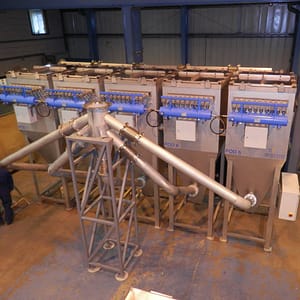
At Glosfume, we specialise in the design and manufacture of ceramic hot gas filtration systems that effectively capture these particulates, even under extreme thermal and chemical conditions. With installations in over 1,000 facilities worldwide—from waste-to-energy plants to uranium oxide production sites—our filters consistently achieve sub-micron particulate control at emission levels far below European limits. This article explores the science behind PM10 and PM2.5, the limitations of traditional filtration technologies, and why ceramic filters offer a technically superior and future-proof solution.
Understanding PM10 and PM2.5: The Basics
Particulate matter refers to solid particles or liquid droplets suspended in the air. These are often categorised based on size. PM10 includes particles less than 10 microns in diameter, while PM2.5 consists of particles under 2.5 microns. For comparison, a human hair is about 70 microns wide, making these particles invisible to the naked eye. Their small size allows them to penetrate deep into the lungs, where they can enter the bloodstream and cause long-term health effects such as respiratory illness, cardiovascular disease, and cancer.
In industrial settings, particularly in combustion-based applications, these particles are produced in abundance. Processes such as biomass wood burning, chemical incineration, and metal ore processing create fine and ultrafine particulate matter as a result of incomplete combustion or high-energy chemical reactions. Due to their microscopic size and light mass, these particulates remain suspended in exhaust gases and are difficult to remove using standard filtration methods.
The Limitations of Traditional Bag Filters
Conventional bag filters—often made of woven or felted fabrics—are commonly used in industrial dust collection systems. While they are suitable for many room-temperature or mildly heated applications, they struggle significantly in environments involving high-temperature gas streams. One of the key issues is that bag filters typically cannot operate above 200°C without suffering damage or total failure. Materials begin to degrade, shrink, or melt, and any acid gases present can accelerate wear by attacking the fabric structure.
Moreover, these filters are generally ineffective at capturing sub-micron particles such as PM2.5. The filter media’s pore size, even when supported by surface coatings, is often too large to trap the finest particulates. As a result, emissions frequently exceed the 10 mg/m³ regulatory limit for dust in the EU, and fines or enforcement actions may follow. To compound this, bag filters usually require extensive ancillary systems—such as heat exchangers, dilution air, cyclones, and spark arresters—which increase installation complexity, footprint, and ongoing maintenance costs.
How Ceramic Filters Capture PM10 and PM2.5
At the core of Glosfume’s success is our proprietary ceramic filter element. These rigid tubes are made from highly engineered fibres and are vacuum-formed to create a porous, stable structure capable of withstanding temperatures up to 1000°C. The filter operates by drawing hot, polluted gases through the porous ceramic wall. Due to the fine microstructure of the outer surface, sub-micron particles—including PM10, PM2.5, and nano-particles—are physically trapped on the exterior of the element, while clean gases pass through and are safely discharged to atmosphere.
As these particles accumulate, a differential pressure develops across the filter wall. When a pre-set limit is reached, the system initiates an automatic reverse pulse cleaning cycle using compressed air. This momentarily reverses the gas flow, dislodging the built-up filter cake and allowing it to fall into a hopper for disposal or recycling. The process ensures that the filters remain effective over long periods with minimal operator intervention.
Proven Performance in Real-World Applications
Between 2007 and 2012 alone, Glosfume installed over 250 ceramic filtration units on biomass-fired boilers, ranging in size from 50kW to 7MW. In each case, the filters significantly reduced PM10 and PM2.5 emissions, enabling projects to gain planning permission and meet regulatory standards—even in densely populated urban areas. In one particularly high-profile case, a food waste-to-energy plant operated by a well-known UK chef was experiencing ash fallout that coated nearby vehicles and buildings. After installation of a Glosfume system, emissions were brought down to well below 3 mg/m³—solving the problem entirely.
Another milestone project involved the UK’s first DEFRA-compliant animal carcass incinerator, built to dispose of infected livestock during a foot-and-mouth outbreak. The plant operated 24/7 and processed up to 4,000 kg/hr of material. Our filters ensured that even under constant heavy load, emissions of PM and acid gases remained within regulatory thresholds.
Integration with Dry Scrubbing for Acid Gas Removal
Many industrial gases do not only contain particulate matter—they also include acidic gases such as hydrogen chloride (HCl), sulphur dioxide (SO2), and hydrogen fluoride (HF). These can be neutralised using dry scrubbing agents like sodium bicarbonate or hydrated lime. However, conventional bag filters can’t tolerate the temperature ranges necessary for effective scrubbing with these substances, leading to poor reactivity, excess reagent use, and in extreme cases, fire risk.
In contrast, Glosfume’s ceramic filtration systems operate comfortably within the optimal range for sodium bicarbonate reactivity—between 140°C and 450°C. Our engineers use Computational Fluid Dynamics (CFD) to model gas flow and particulate distribution within the filtration chamber, ensuring even coverage of all filter elements and optimal utilisation of the scrubbing agent. This not only improves pollutant capture but also reduces overall reagent costs and landfill burden.
In-House Engineering and Customisation
Unlike many competitors, Glosfume manufactures over 90% of all filter system components in-house. From ceramic element production to filter housing fabrication, our vertically integrated approach gives us full control over quality, delivery timelines, and design flexibility. For customers with special requirements, we regularly develop tailored systems using our modular HTMC design. These systems can be installed in line, side-by-side, or in parallel to handle varying gas volumes without the need for full system shutdown during maintenance.
Our filter heads are laser cut for precision alignment between the elements and cleaning jets, ensuring reliable and repeatable cleaning cycles. Systems are fitted with PLC-based control panels and touch screens that offer remote monitoring, multi-language support, and data logging for traceability. Thanks to barcoded packaging and database tracking, every filter element we ship is fully traceable from batch to installation.
Compliance, Reliability, and Long-Term Value
With emission standards becoming ever more stringent, it is crucial for industrial operators to invest in systems that are not only compliant today, but also ready for the tighter regulations of tomorrow. Glosfume systems offer exactly this assurance. In tests conducted at nuclear fuel manufacturing sites in France, our filters recorded particulate emissions as low as 0.0017 mg/m³—far below the EU’s most rigorous thresholds.
Unlike disposable or fast-degrading filter media, Glosfume ceramic elements are built to last. Depending on the application and maintenance practices, service life can extend to several years. When replacement is necessary, elements are readily available from our UK stock, ensuring minimal downtime and cost predictability.
In the face of growing environmental scrutiny and more aggressive regulatory enforcement, addressing PM10 and PM2.5 emissions is no longer optional. With their unmatched thermal resilience, chemical resistance, and fine-particle capture capabilities, Glosfume ceramic filtration systems represent the gold standard in high-temperature filtration. Whether you’re operating a biomass boiler in a city centre, a waste incinerator on a coastal site, or a heavy metals processing plant, we have the technology and the expertise to help you meet your environmental responsibilities with confidence.