



Introduction: The NHS’s Commitment to Sustainability
The NHS has long been at the forefront of implementing sustainable practices, recognising the importance of reducing its carbon footprint while maintaining high-quality healthcare services. As one of the UK’s largest employers and energy consumers, the NHS has set ambitious goals to achieve net-zero carbon emissions by 2040.
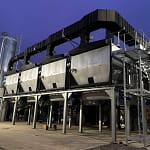
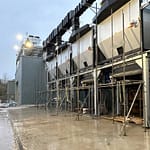
One example of this commitment is the Blackpool Harbour Facility, a £40 million mental health unit operated by the Lancashire Care NHS Foundation Trust. Designed to meet stringent BREEAM sustainability standards, the facility required a heating system that could deliver reliable, efficient, and environmentally friendly performance in compliance with urban air quality regulations. The solution came in the form of an 800kW biomass boiler paired with Glosfume’s advanced ceramic filtration system. This cutting-edge technology ensured emissions compliance, operational efficiency, and cost-effectiveness.
The Problem: Emissions Compliance and Energy Costs
Energy Demands in Healthcare
Healthcare facilities like the Harbour Facility have demanding energy requirements, especially in inpatient units. The heating system needed to provide consistent warmth and hot water for 154 beds and associated services, operating around the clock with minimal interruptions. However, achieving this level of reliability while adhering to strict emissions standards posed significant challenges.
Emissions Challenges
- Particulate Emissions: The biomass boiler emitted fine particulates, including PM10 and PM2.5, which are harmful to both human health and the environment. Urban healthcare facilities face heightened scrutiny due to their proximity to populated areas.
- Acid Gases: Emissions of hydrochloric acid (HCl) and sulphur dioxide (SO₂) risked exceeding the limits set by the Industrial Emissions Directive (IED), threatening the facility’s compliance and sustainability goals.
Operational and Financial Risks
In addition to emissions challenges, the Harbour Facility’s initial filtration system experienced frequent clogging and maintenance issues. This led to:
- Increased operational costs due to frequent filter replacements and maintenance.
- Disruptions in heat supply, impacting the comfort and care of patients and staff.
- Potential fines and operational restrictions for failing to meet emissions standards.
- Loss of eligibility for Renewable Heat Incentive (RHI) funding, a vital revenue stream for biomass boiler installations.
The Solution: Glosfume’s Ceramic Filtration Technology
Key Features of the Glosfume Filtration System
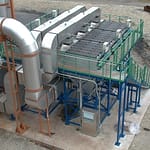
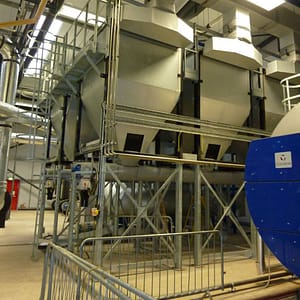
Glosfume designed a bespoke filtration system to address the Harbour Facility’s specific challenges. The key components included:
- High-Efficiency Ceramic Filters: Capable of capturing 99.99% of sub-micron particulates, ensuring compliance with stringent PM10 and PM2.5 limits
- Integrated Dry Scrubbing System: Neutralises acid gases (HCl, SO₂) by injecting sodium bicarbonate into the gas stream. The resulting neutralised salts are captured by the ceramic filters.
- High-Temperature Resilience: Filters designed to perform reliably in environments up to 1000°C, suitable for biomass boiler operations.
Reverse-Pulse Cleaning Mechanism
The system features an automated reverse-pulse cleaning mechanism that dislodges particulates from the filter surface using compressed air. This ensures consistent airflow, minimises pressure drop, and eliminates the need for manual cleaning, significantly reducing downtime.
Tailored System Design and Installation
Glosfume conducted a detailed assessment of the Harbour Facility’s energy and emissions requirements before designing the system. The modular design allowed for seamless integration with the existing biomass boiler infrastructure, ensuring minimal disruption during installation. The system’s scalability also means it can accommodate future expansions or increased energy demands.
The Results: Emissions Compliance and Operational Excellence
Achieving Emissions Compliance
The Glosfume filtration system achieved remarkable results in emissions reduction:
- Particulate Emissions: PM10 and PM2.5 levels were reduced to well below IED thresholds, protecting local air quality in the urban area.
- Acid Gas Emissions: Neutralisation of HCl and SO₂ ensured full compliance with environmental regulations and reduced the risk of equipment corrosion.
Operational Benefits
The advanced design of the ceramic filters and reverse-pulse cleaning mechanism provided significant operational advantages:
- Minimised downtime due to reduced maintenance demands.
- Enhanced boiler efficiency, ensuring a reliable heat supply for the facility.
- Extended service life of the ceramic filters, lowering replacement costs over time.
Financial Impact
- Energy Cost Savings: The low-pressure drop design reduced energy consumption, cutting operational costs.
- Eligibility for RHI Funding: Compliance with emissions standards allowed the facility to secure RHI funding, providing a vital financial incentive.
Lessons Learned: A Blueprint for Sustainable Healthcare
Customised Solutions for Critical Facilities
This project demonstrated the importance of tailoring emissions control systems to the unique needs of healthcare facilities, where uninterrupted operation and compliance are non-negotiable.
Future-Proof Technology
The durability and scalability of the Glosfume system provide a long-term solution, ensuring continued compliance with evolving environmental regulations.
Balancing Efficiency and Sustainability
The Harbour Facility achieved a balance between operational efficiency, cost savings, and sustainability, setting a benchmark for other NHS facilities to follow.
Applications Beyond Healthcare
Glosfume’s ceramic filtration systems are not limited to healthcare. They are equally effective in other sectors with demanding emissions requirements, including:
- Energy-from-Waste Facilities: Managing complex emissions while recovering energy efficiently.
- Public Sector Buildings: Schools and government offices that rely on biomass boilers can benefit from similar systems.
- Industrial Applications: Metals and mining operations, as well as hazardous waste incineration, require robust filtration systems to meet stringent environmental standards.
A Model for Cleaner Heat in Healthcare
The successful implementation of Glosfume’s ceramic filtration system at Blackpool’s Harbour Facility demonstrates the transformative potential of advanced emissions control technology. By achieving compliance, improving operational efficiency, and reducing costs, the Harbour Facility has set a new standard for sustainable healthcare operations.
As the NHS continues its journey toward net-zero emissions, projects like this showcase the value of investing in innovative solutions. Glosfume remains committed to supporting the healthcare sector and beyond, ensuring a cleaner, more sustainable future.