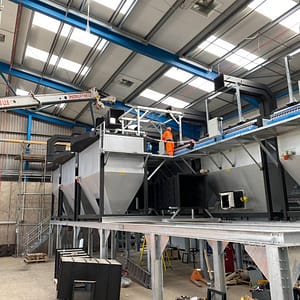




Industrial combustion processes—ranging from biomass boilers to incinerators and metal furnaces—are significant sources of airborne particulate emissions. Among these, PM10 and PM2.5 are particularly harmful due to their ability to penetrate deep into the lungs and bloodstream. As environmental legislation tightens and air quality standards become stricter across the UK and Europe, reducing fine particulate emissions has become a priority for plant operators.
Glosfume has developed ceramic hot gas filtration systems specifically designed to capture these ultra-fine particles, delivering emissions performance well below regulatory limits—even in high-temperature, high-particulate applications.
What Are PM10 and PM2.5?
PM10 refers to particles with a diameter of 10 microns or less, while PM2.5 includes even smaller particles of 2.5 microns or less. These particles are typically formed during combustion and include ash, carbon, metal oxides, and unburnt hydrocarbons. Because of their small size, they are not visible to the naked eye but can pass through conventional filtration systems and linger in the environment for extended periods.
Health studies link exposure to PM2.5 with asthma, cardiovascular disease, and respiratory illness, making their control a top priority in public health policy and industrial permitting.
Why Traditional Filters Struggle with Fine Particulates
Standard bag filters may capture larger particles, but they struggle with sub-micron emissions. Fabric media is not only sensitive to heat and acid gases but often has pore sizes that allow PM2.5 to pass through. Even when coated, performance is inconsistent—especially under fluctuating temperature and humidity.
In contrast, ceramic filter elements operate at up to 1000°C and offer a stable, micro-porous barrier to fine particulates. They resist chemical degradation and provide consistent filtration performance without reliance on dilution air or cooling.
Glosfume Ceramic Filters: A Proven Solution
Glosfume’s filtration systems use advanced ceramic filter elements developed in-house for precision particulate control. These elements are formed using engineered fibres and vacuum technology to produce a uniform, dense wall structure. The surface is often treated with a micro-porous coating to enhance the capture of PM10, PM2.5, and even nano-particles.
Once particulates build up on the outer wall of the element, a reverse pulse of compressed air dislodges the filter cake without damaging the ceramic structure. This ensures consistent emissions control with minimal pressure drop over time.
Tested and Verified Performance
In independent tests and real-world installations, Glosfume systems have achieved:
- PM emissions as low as 0.7 mg/m³ in biomass and incineration
- Sub-micron particle capture efficiency above 99.99%
- PM2.5 removal rates suitable for urban and sensitive environments
For reference, EU Industrial Emissions Directive limits for PM typically require less than 10 mg/m³. Glosfume’s technology easily exceeds this standard—often by a factor of 10 or more.
Application Versatility
Our systems are currently installed in a range of combustion applications, including:
- Wood-fired biomass heating systems (50 kW to 7 MW)
- DEFRA-approved animal carcass incinerators
- Metal recovery plants (aluminium, lead, bronze, tin)
- Waste-to-energy and combined heat and power (CHP) plants
In each case, our ceramic filters have enabled the site to meet or exceed local air quality permit conditions—often unlocking planning permissions in urban or sensitive locations where bag filters could not comply.
Future-Ready Compliance
As public and regulatory focus intensifies around PM2.5, investing in a filtration solution that performs below current limits is a strategic decision. Glosfume systems offer long-term resilience by eliminating the need for cooling air, fabric bag replacements, or secondary filtration.
Our modular designs allow for future expansion or system upgrades, and our ceramic filters are fully compatible with dry scrubbing for simultaneous removal of acid gases and dioxins.
Capturing PM10 and PM2.5 emissions is no longer an optional extra—it’s a core requirement for any modern combustion system. Glosfume’s ceramic filtration technology delivers the performance, reliability, and compliance margin that operators need to meet today’s limits and tomorrow’s expectations.