



Many industrial plants rely on legacy filtration systems—often baghouses or cyclones—that weren’t designed for today’s emissions standards or process temperatures. As regulations tighten and dust properties shift, retrofitting ceramic filtration offers a route to improved performance without a complete system rebuild. But what’s involved in the transition?
This article explains the practical aspects of upgrading from traditional filters to high-efficiency ceramic elements—covering layout changes, emissions benefits, and key considerations during design and commissioning.
Why Retrofit to Ceramic Filters?
Ceramic filters provide several advantages over fabric or metal media in high-temperature and fine particulate applications:
- Continuous operation up to 1000°C without filter degradation
- Sub-micron particle capture down to PM2.5 and below
- Dry operation—no water, scrubbing, or effluent treatment
- Longer element life (2–5 years) with minimal maintenance
- Low and stable pressure drop with pulse-jet cleaning
Retrofitting allows existing plants—particularly those in energy-from-waste, metals processing, or gasification—to meet tighter air quality limits and lower operating costs without starting from scratch.
What Can Be Reused – and What Can’t
The feasibility of a ceramic retrofit depends on the condition and design of the existing filtration system. In some cases, parts of the housing, ductwork, and hopper can be retained. In others, a full module replacement may be more cost-effective due to layout, insulation, or access constraints.
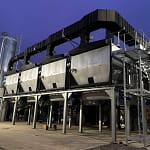
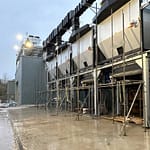
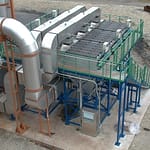
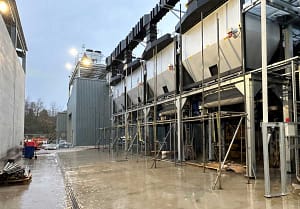
Ceramic filters require vertical mounting, integrated backpulse nozzles, and a tight seal between clean and dirty sides. Baghouse frames are often too wide or too short for optimal ceramic layout. However, Glosfume has developed compact, bespoke filter modules that can slot into legacy housing footprints with minimal disruption.
Managing the Retrofit Process
A typical retrofit involves:
- Site survey and dimensional analysis of existing system
- CFD modelling to ensure balanced gas flow to each element
- Pulse system specification, including compressor sizing
- Skid-mounted or modular delivery to minimise installation time
- Commissioning support with thermal ramp-up and flow balancing
Downtime can be limited to a few days depending on complexity, especially when pre-assembled filter blocks are used. For systems requiring simultaneous emissions compliance, temporary bypass filters or staged cutovers can be arranged.
Results You Can Expect
In a recent metals recovery plant retrofit, particulate emissions dropped from 15 mg/m³ to under 1 mg/m³ immediately after installing ceramic filters. Pulse cleaning extended element life to over 30 months, and fan energy use decreased by 20% due to stable pressure drop.
Other benefits included reduced visible plume, simplified maintenance schedules, and full elimination of water handling and bag replacement waste.
Retrofitting to ceramic filtration offers a clear path to emissions compliance, lower OPEX, and long-term system reliability. While not every system is retrofit-ready out of the box, modern ceramic modules can be tailored to match existing layouts—and often outperform the original system in footprint, efficiency, and maintainability.
For plants facing emissions pressures or performance constraints, a retrofit isn’t just possible—it may be the smartest move forward.