



Biomass gasification offers a renewable pathway to energy and fuels—but it comes with unique filtration challenges. One of the most common is fine ash and particulate carryover, especially in systems running at 700–1000°C. These particles are often sub-micron in size and chemically reactive, making them difficult to capture with standard filters.
This article explores how ceramic filtration addresses what traditional baghouses miss in biomass gasification—and why controlling PM2.5 and nano-particulates is critical not just for emissions, but for equipment protection and syngas quality.
The Nature of Biomass Ash
Unlike coal or waste combustion, biomass fuels contain high levels of alkali metals, chlorine, and volatile organics. When gasified, they form fine ash particles, potassium salts, and sticky tars. These particulates can condense in ducts, corrode metalwork, or foul downstream components like gas engines, scrubbers, or catalysts.
Many of these particles fall well below the PM10 range, requiring filtration performance below 1 mg/m³—and often under 0.5 mg/m³—to protect downstream units and meet clean syngas specifications.
Why Standard Filters Struggle
Bag filters and multicyclones are often used in gasification but face several limitations:
- Bag filters degrade above 250–300°C and may require cooling, increasing tar condensation risk.
- Cloth bags can blind rapidly due to sticky ash, leading to short cleaning cycles and high maintenance.
- Submicron ash and re-entrained particles often bypass mechanical separation entirely.
In short, traditional filtration systems may reduce visible dust but still allow harmful ash to pass through—compromising syngas usability and long-term system health.
Ceramic Filters: A Better Match for Biomass Gasification
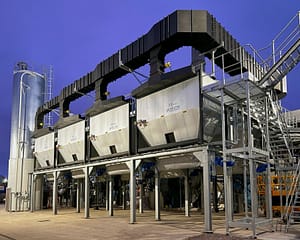
Ceramic filtration systems offer surface-level particulate capture at temperatures up to 1000°C. Their rigid, non-porous structure resists clogging and thermal degradation, even in fluctuating biomass environments.
More importantly, ceramic elements filter particles down to PM2.5 and below, achieving ultra-low emissions and clean gas for engines, turbines, or catalytic systems. With pulse cleaning, filters maintain stable pressure drop and prevent ash accumulation—even with variable feedstock and gas load.
Case Example: Syngas Engine Protection
In a 1.5 MW biomass gasification project running on wood chips, operators faced premature failure in gas engine valves due to fine ash ingress. After switching from a cooled bag filter to a ceramic hot gas filter, PM emissions dropped to 0.2 mg/m³ and engine lifespan doubled. Cleaning frequency was reduced, and no tars condensed in the filter housing—thanks to elevated operating temperatures.
Supporting Carbon-Negative Operations
Many biomass gasification systems aim for carbon-negative operation by capturing CO₂ or producing biochar. Filtration plays a critical role here: cleaner syngas means more efficient combustion, less fouling, and better performance in carbon capture stages.
By removing fine ash without scrubbing or cooling, ceramic filters simplify integration with recovery units and reduce parasitic loads on the system.
Fine ash in biomass gasification isn’t just an emissions issue—it’s a system integrity challenge. Ceramic filtration offers a proven, high-temperature solution for capturing PM2.5 and nano-particulates before they harm downstream processes. For operators aiming for long runtimes, clean syngas, and robust emissions control, it’s a key design decision that pays off across the entire value chain.