



Activated carbon regeneration and reactivation processes are essential in industries such as water treatment, food processing, chemical refining, and environmental remediation. By heating spent carbon to remove adsorbed compounds, these systems recover valuable media — but also produce hot, dusty, and often volatile gas streams that must be carefully filtered before discharge.
Ceramic filtration provides a dry, robust, and high-efficiency solution for controlling emissions in carbon reactivation kilns and thermal regeneration systems. Operating at up to 1000°C, ceramic filters capture PM2.5, VOC-derived particulates, and metallic ash — all while avoiding combustion risks common in carbon-rich applications.
PM2.5, VOCs, and Dust in Carbon Kiln Off-Gas
During regeneration or reactivation, activated carbon is typically heated in a rotary kiln, fluidised bed, or multi-hearth furnace. Organic contaminants are desorbed and often pyrolysed, generating:
- Fine carbon dust and reactivated char particles
- Volatile organic compounds (VOCs)
- Residual metals and mineral ash
These compounds are entrained in the hot gas stream — often at 600–950°C — and can lead to visible emissions, odour, and environmental non-compliance if not properly filtered. Traditional bag filters are unsuitable due to fire risk, while wet scrubbers may not effectively capture PM2.5 or sticky particulates.
Ceramic Filters for Carbon Processing Lines
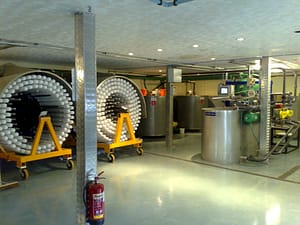
Glosfume ceramic filter elements are built for dry, high-temperature dust capture in reactive gas streams. They’re particularly effective in carbon reactivation due to:
- Non-combustibility — safe in spark-prone dust streams
- Thermal stability up to 1000°C
- Surface filtration with ≥99.99% PM2.5 efficiency
- Pulse-jet cleaning for continuous online operation
- Resistance to acidic or VOC-laden gas
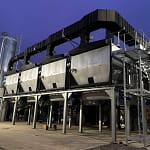
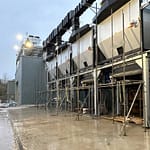
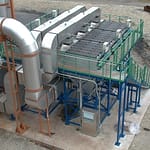
Filters are housed in insulated steel vessels with compact footprints and modular design. Dust is removed via hopper and can be reprocessed, packaged, or safely disposed depending on application.
Case Study: Ceramic Filters on Carbon Reactivation Kiln
A European carbon processor operating a rotary reactivation kiln for water treatment carbons needed to replace ageing wet scrubbers and reduce visible stack emissions. The off-gas carried fine carbon dust, reactivation by-products, and traces of odorous VOCs.
Glosfume supplied a ceramic filter system for 6,000 m³/h of flue gas at 780°C. Features included:
- 48 ceramic elements in vertical housing
- Pulse-jet cleaning triggered by pressure differential
- Dry sorbent injection for acid gas polishing
- Stainless steel dust recovery bin for reprocessed carbon
Within two weeks of commissioning:
- Dust emissions dropped below 1 mg/m³
- Odour was reduced by over 90%
- Filter elements showed no degradation after 12 months
- Plant met all local air quality and process safety standards
Fire Risk Reduction and Safety Advantages
One of the major benefits of ceramic filters in carbon handling is the elimination of combustible filter media. Unlike bags, ceramic elements do not ignite if exposed to sparks or glowing carbon dust — a known risk in regeneration lines.
The filters also operate without water or quenching, avoiding the creation of contaminated effluent or the risk of thermal shock. This makes ceramic filtration a safer and more sustainable long-term solution for carbon reactivation facilities operating under tight regulatory controls.
Design Flexibility and System Integration
Modular ceramic filtration systems are easily scaled to match reactivation line throughput — from 2,000 to over 20,000 m³/h. Systems can be installed inline after kilns, or in side-stream configurations to support VOC control before condensers or oxidisers.
Integration options include:
- Automated control panels with remote monitoring
- Pulse sequencing for variable loading rates
- Pre-filtration for coarse ash removal
- Compliance logging for emissions reporting
Compact housings allow installation within existing plant footprints, and filter elements are easy to inspect, replace, and manage on-site — often lasting 24–36 months depending on dust loading and maintenance.
Ceramic filters offer a high-integrity, dry filtration option for activated carbon regeneration and reactivation systems. With safe operation at 1000°C, high PM2.5 removal efficiency, and minimal maintenance, they help operators reduce emissions, improve plant safety, and meet tightening environmental standards.
For carbon handling lines requiring dust capture, VOC reduction, and filter fire prevention, ceramic filtration represents a durable, future-ready solution already proven in multiple industrial applications.